
Testing and Certification for Navigation Lights and Marine Lighting Products
Marine navigation lights play a critical role in vessel visibility, communication, and safe operation. Whether installed on a recreational boat, commercial vessel, tug, workboat, or larger ship, navigation lighting must meet specific requirements for light output, color, visibility, environmental durability, and mechanical performance.
Intertek provides independent testing and certification services for marine and maritime lighting products, helping manufacturers demonstrate compliance with applicable U.S. Coast Guard (USCG), ABYC, international, and industry requirements.
As a U.S. Coast Guard accepted laboratory, Intertek helps manufacturers evaluate navigation lighting products for regulatory compliance, product performance, and market acceptance.
Marine Navigation Lighting Compliance
Navigation light requirements vary depending on vessel type, size, operating environment, and intended market. Manufacturers must consider more than basic electrical safety. Products may also need to demonstrate the required luminous intensity, chromaticity, horizontal and vertical visibility, resistance to vibration and shock, environmental durability, and protection against water ingress and corrosion.
Intertek works with manufacturers to identify applicable requirements early in product development and establish a testing program based on the intended vessel and market.
Standards and Regulations We Support
- 33 CFR Part 83 – Inland Navigation Rules
- 33 CFR Part 84 – Annex I: Positioning and Technical Details of Lights and Shapes
- 46 CFR §111.75-17 – Navigation Lights
- International Regulations for Preventing Collisions at Sea (COLREGS 72)
- ABYC A-16 – Installation of Electric Navigation Lights
- ABYC C-5 – Construction and Testing of Electric Navigation Lights
- IEC 60068-2-27 – Environmental Testing – Mechanical Shock
- IEC 60529 – Degrees of Protection Provided by Enclosures (IP Code)
- IEC 60945 – Maritime Navigation and Radiocommunication Equipment and Systems
- RTCM Standard 13700.0 – Navigation Lights
ABYC C-5 and U.S. Coast Guard Acceptance
ABYC C-5 provides requirements for the construction and testing of electric navigation lights used on vessels. Its acceptance by the U.S. Coast Guard as an equivalent pathway to UL 1104 gives navigation light manufacturers another route for demonstrating compliance with applicable federal requirements.
For manufacturers developing new LED navigation lights or updating existing product families, Intertek can help determine the appropriate testing and certification pathway based on product design and intended application.
Marine Lighting Testing Capabilities
- Luminous intensity
- Nautical mile visibility rating
- Horizontal intensity distribution
- Vertical intensity distribution
- Colorimetry and chromaticity
- Light output and distribution
- Flash characteristics, where applicable
- Vibration
- Mechanical shock
- Dry heat
- Low-temperature exposure
- Temperature cycling
- Corrosion and salt-fog exposure
- Solar radiation
- Rain and spray
- Water ingress and IP testing
- Housing temperature
- Environmental durability
- Electrical performance
- Electromagnetic compatibility (EMC)
- Emissions and immunity
- Voltage variation
- Power and operational performance
- Additional evaluations required by applicable standards
Intertek supports testing for a wide range of vessel navigation lights, including:
- Masthead lights
- Stern lights
- Port sidelights
- Starboard sidelights
- Combination sidelights
- All-round lights
- Anchor lights
- Towing lights
- Flashing lights
- Special flashing lights
- LED marine navigation luminaires
- Other vessel identification and signaling lights
Testing can address products intended for both commercial vessels and smaller recreational or work vessels, including boats less than 12 meters in length.
Testing for Harsh Marine Environments
Marine lighting products operate in environments that can be significantly more demanding than conventional lighting applications. Products may be continuously exposed to moisture, salt spray, vibration, temperature extremes, ultraviolet radiation, and mechanical stress.
Intertek combines its lighting performance capabilities with environmental and mechanical testing to evaluate how navigation lights perform under these conditions.
Where multiple standards apply, manufacturers may also be able to coordinate testing within a single compliance program, helping reduce duplicated testing and streamline product development.
Accredited Marine Lighting Testing
Intertek provides marine lighting testing through laboratories accredited to ISO/IEC 17025, including accreditation by the American Association for Laboratory Accreditation (A2LA) for applicable testing scopes.
As a U.S. Coast Guard accepted laboratory, Intertek supports manufacturers seeking to demonstrate compliance with applicable USCG navigation lighting requirements.
Why Intertek?
Intertek has been testing lighting technologies for more than a century, with lighting expertise dating back to Electrical Testing Laboratories and the earliest commercial electric lighting technologies. Today, Intertek provides safety, performance, environmental, and certification services for lighting manufacturers around the world.
For marine and maritime lighting manufacturers, Intertek offers:
- S. Coast Guard accepted laboratory capabilities
- ISO/IEC 17025 accredited testing
- Optical and photometric expertise
- Environmental and mechanical testing
- EMC testing
- North American and international standards expertise
- Support from prototype development through certification
- Access to Intertek's global network of testing and certification resources
Marine Lighting - Frequently Asked Questions (FAQs)
Requirements depend on the vessel, product design, installation, and intended market. Common requirements include 33 CFR Parts 83 and 84, COLREGS 72, ABYC C-5, ANSI/UL 1104, IEC 60945, and other applicable environmental and performance standards.
ABYC C-5 establishes construction and testing requirements for electric navigation lights. It addresses performance characteristics important to navigation lighting and provides a compliance pathway for qualifying marine navigation light products.
ABYC A-16 primarily addresses the installation of electric navigation lights on vessels, while ABYC C-5 addresses the construction and testing of the navigation light itself.
Certain navigation lights installed on U.S. vessels are subject to USCG requirements, including requirements related to visibility, positioning, construction, and independent laboratory certification or acceptance depending on the vessel and application.
The nautical mile rating describes the required visibility range of a navigation light. Required ranges vary depending on the type of light and vessel.
Depending on their function, navigation lights may be white, red, green, or yellow. Standards define chromaticity boundaries to ensure the displayed color can be correctly identified by other vessels.
LED technology can introduce considerations involving optical distribution, color consistency, thermal management, electronics, and long-term performance. The applicable standard determines the required evaluations.
Yes, applicable standards may require evaluations such as vibration, shock, temperature, water exposure, corrosion, and other environmental testing to verify that the light continues to function under marine operating conditions.
Yes. Pre-compliance testing can help identify potential optical, environmental, mechanical, or electrical issues before formal certification testing begins.
Yes. Intertek's global laboratory network supports testing to U.S., international, and industry requirements. The appropriate compliance program depends on the product and intended markets.
Related Links
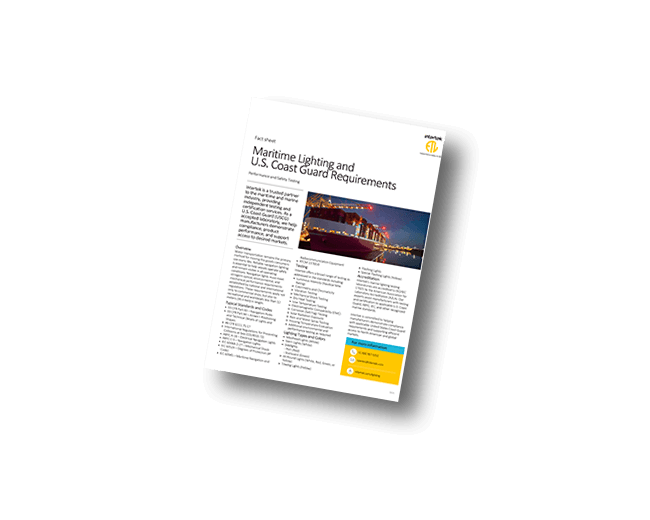
Maritime Lighting & US Coast Guard Requirements | Fact Sheet
Navigation lights must meet specific optical, environmental, and mechanical performance requirements to support vessel safety and regulatory compliance.
12 Aug 2026
ABYC C-5 Now Recognized as an Equivalent to UL 1104 by the U.S. Coast Guard
What Boat Builders Need to Know
Knowledge Center
Low Voltage Lighting Products Testing and Certification Fact Sheet
Considerations in Bringing a Germicidal Product to Market Webinar
Commercial Displays: Compliance to ANSI/UL 970 Fact Sheet
Lighting for Hazardous Locations Fact Sheet
Germicidal Lighting Fact Sheet
Horticultural Lighting Safety & Performance Criteria Fact Sheet
Product Listing & Marking Strategies White Paper
Mitigating Cyber Threats to Connected Lighting Products Webinar
Automotive Lighting: Photometric Concepts, Calibration, and Measurement White Paper
Class P Program for LED Light Engines Fact Sheet
ANSI/UL 8750: Overview and Tips for Manufacturers
Ingress Protection for Lighting Products IP vs. NEMA Ratings White Paper
California Energy Commission (CEC) Title 20 and Title 24 White Paper
Resources
- Global Lighting Standards
- ETL Listed Mark - proof of product compliance to North American safety standards
- Reese's Law – ANSI/UL 4200A-2023
- Sustainability Solutions for Lighting
- My Test Central
- Product Directories
- Certification Marks
- Global Market Access
- SatelliteTM Client Test Program
- Intertek Protek - The world’s first industry-agnostic, end-to-end health, safety and wellbeing assurance program
- Intertek Performance Gateway